How to play “I Will Wait”
How to play “I will wait” Mumford and Sons – fingerstyle ukulele. A beautiful song, and not too hard to get the melody right out of the chord shapes.
The chord namer will automatically name a chord shape (if a valid chord shape is supplied.) Simply select the circles on the fret board that correspond to where your fingers go and hit “Go”. A few things to watch out for:
Strings that aren’t strummed should be set to “Mute” and open strings should be set to zero.
Don’t enter your chord upside-down! The fretboard is shown with the lowest pitch string at the bottom and the highest pitch string at the top (unless you’ve tuned your instrument differently.)
If there is more than 1 way to name the chord you supplied, the chord namer will give you multiple results. They are all correct but which one you choose may depend on the context it is used in. Visit chord namer here!
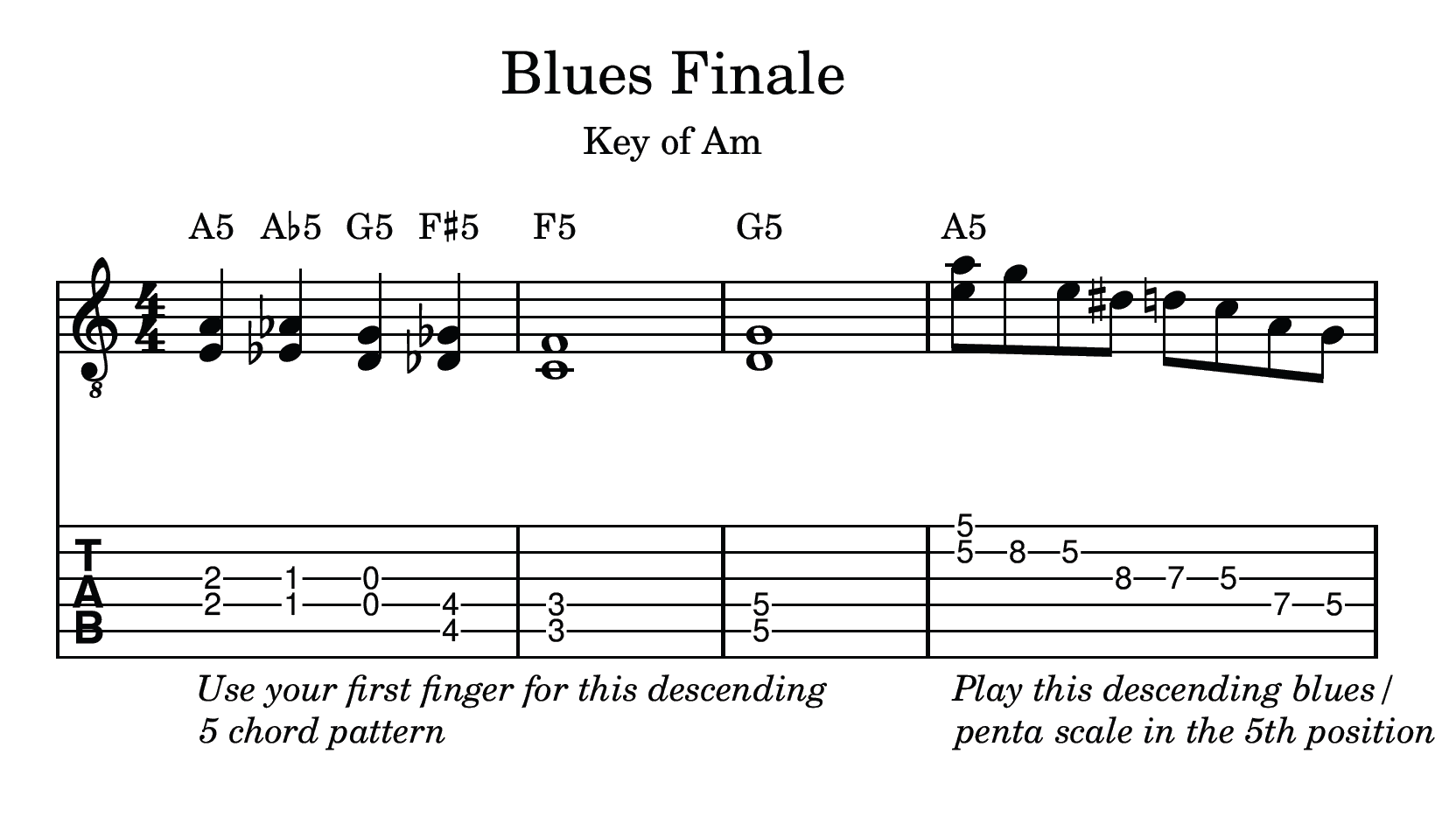
“Muddy Waters meets Tiny Tim”, as my friend and teacher John LaGreca said. This blues will be in Am. Using a 1/4/5 pattern, that gives us Am for the 1, D, for the 4 and E for the 5.


We can play a typical 12 bar blues pattern
like this:
The 12th measure with the 5 chord is the “turnaround”.
We can use our pentatonic minor scale to play over the chords! The minor pentatonic scale uses the 1, b3, 4, 5 and b7 notes. for Am that would be A, C, D, E and G and that works great for the 1 and 4 chords. We can also use the “blue” note (b5) to make it sound cooler.
For the 5 chord, we’ll use the pentatonic for E. Again, 1, b3, 4, 5 and b7, o that will be E, G, A, B and D. The b5 in this scale is a Bb.
You can use any note as a “passing” note though, as long […]
Looking for online ukulele lessons? First one is free!
“Muddy Waters meets Tiny Tim”, as my friend and teacher John LaGreca said. This blues will be in Am. Using a 1/4/5 pattern, that gives us Am for the 1, D, for the 4 and E for the 5.


We can play a typical 12 bar blues pattern
like this:
The 12th measure with the 5 chord is the “turnaround”.
We can use our pentatonic minor scale to play over the chords! The minor pentatonic scale uses the 1, b3, 4, 5 and b7 notes. for Am that would be A, C, D, E and G and that works great for the 1 and 4 chords. We can also use the “blue” note (b5) to make it sound cooler.
For the 5 chord, we’ll use the pentatonic for E. Again, 1, b3, 4, 5 and b7, o that will be E, G, A, B and D. The b5 in this scale is a Bb.
You can use any note as a “passing” note though, as long […]
If you’re looking for online zoom or skype guitar lessons, I might be just the right teacher for you! I work with guitarists and ukulele players of all levels and abilities and I have students from all over!
Online students from across the country!
To make sure I am a good fit for you, I offer a free initial online lesson. No matter what level you are playing at now, I’m willing to bet my own time that you’ll benefit from online lessons with me- and you’ll discover that yourself at your first FREE lesson!
Simply schedule your free lesson for yourself here. The online scheduling tool is quite easy to use; simply choose “First Free Lesson” from the lesson choices and select the day and time you are interested in. If you see a time listed in the scheduler, that time is available for us to meet.
I’m looking forward to meeting you soon!
Paul

How to play “Your Song” Elton John – fingerstyle guitar. A beautiful song, and not too hard to get the melody right out of the chord shapes.
Download the pdf: transpose-guitar
So let’s say you want to transpose C, F and G (the 1, 3 and 5 notes which make a CM triad) to the key of E. What you’re saying is “if C is now E, then F=A and G=B. All you’re looking for when you transpose is the same relationships in a scale with a different root so 1/4/5 in C is C/F/G which relate to E/A/B in the target key.
I hope this is helpful!
Don’t practice until you […]
How to play “Donkey Riding” on ukulele. Download the tabs here
a simple two-part harmony on uke.
Donkey Riding had its origins with the sailors that left Glasgow and Liverpool on a regular basis to bring back lumber from Canada. It is not precisely a sea chanty, but more of a work song. The “Donkey” in the title is not the animal, it is the engine that was used in loading cargo in the ship’s deck. I’m recalling my days on the USS Richard L. Page – the bos’n mates maintained something called a donkey boiler or a donkey engine, so that makes sense, finally.
The melody is derived from the well known Scottish marching song, Highland Laddie.
A great old tune I remember my ma singing for me when I was little, she probably heard it from her da, who was a sailor.
This is not too hard to finger on uke right out of the chord shapes and it might be an opportunity to play familiar chords in a different spot on the neck.
Enjoy!
How to play “Something” on guitar. Play the first part of this lovely Lennon/McCartney song for solo guitar. The chord changes are fairly easy and the melody can be picked right out of the chord shapes! The think I really like about it is that beautiful chromatic drop- CM, CM7, C7 to the F, so we’re dropping the notes from C to C to Bb to A. I find it’s a great way to introduce the CMm CM7 and C7 chords to new guitar players!
“The musician is perhaps the most modest of animals, but he is also the proudest.” – Erik Satie
How to play jinglebell rock on guitar fingerstyle for solo guitar. What a great holiday song to get under your hands… and not too hard to do. “Jingle Bell Rock” is an American Christmas song first released by Bobby Helms in 1957. It, alongside various cover versions, have received frequent airplay in the United States during every Christmas season since then, and is generally considered Helms’s signature song. “Jingle Bell Rock” was composed by Joseph Carleton Beal and James Ross Boothe, although both Helms and session guitarist on the song Hank Garland disputed this (see Authorship controversy section below). Beal was a Massachusetts-born public relations professional and longtime resident of South Ocean Avenue in Atlantic City, New Jersey, and Boothe was an American writer in the advertising business.
“Discipline will only teach the techniques – a great teacher gives discipline, motivation and love” -Maury Massler
Download tabs and notation pdf
How to play “La Vie en Rose” fingerstyle on ukulele.
“La Vie en rose“ (French for ‘Life in pink’; pronounced [la vi ɑ̃ ʁoz]) is the signature song of French singer Édith Piaf, written in 1945, popularized in 1946, and released as a single in 1947. The song became popular in the United States in 1950, when seven versions reached the Billboard charts. These recordings were made by Tony Martin, Paul Weston, Bing Crosby (recorded 22 June 1950), Ralph Flanagan, Victor Young, Dean Martin, and Louis Armstrong.
A version in 1977 by Grace Jones was also an international hit.
The song’s title can be translated as “Life in happy hues”, “Life seen through rose-coloured glasses”, or “Life in rosy hues”; its literal meaning is “Life in Pink.”
The lyrics of the song were written by Piaf, with music composed by Louiguy, and is registered with SACEM. It was probably Robert Chauvigny who completed the music. When Piaf suggested to Marguerite Monnot that she sing the piece, the latter rejected “that foolishness.” It was eventually Louiguy who accepted authorship of the music. The song was broadcast live before […]