


How do you start a Hammond Organ?
How do you start a Hammond organ?
Depends on the model. Check the side of your organ. Is there a button, or perhaps a switch? On older models there may be a handle attached to a rope, which you must pull while bracing one foot against the bench. Also they can be notoriously hard to start in cold weather. Feel around the back, upper right hand corner for a choke lever. Push it all the way forward. Right below that is a sort of a black rubber thing- press it all the way in once or twice, then tug on the cord a couple of times to get the gas flowing into the carb. Then give the rope a couple of good yanks. If the organ turns over, you’re good to go. If not, set the choke to about half way and repeat the procedure.
If none of this works, you may need a jump, so get a couple of friends to wheel in another organ. put them back-to-back so your jumper cables will be long enough to go between the battery terminals on both organs. Start the second organ, being careful to match the proper sides of the batteries! Red to red and black to black- otherwise you can damage both organs.
Once you get it started, let it idle a while until it’s warmed up.
Happy organizing!
Boat’s got a hole
The phrase “the boat’s got a hole” serves as a powerful metaphor for the modern psyche, capturing a collective sense of quiet desperation, vulnerability, and shared fate. This imagery mirrors the current mental and emotional states- for many of us:
1. Inevitable, Slow-Motion Crisis
The Psyche: Many people feel a persistent, low-grade anxiety about the future rather than a sudden panic.
The Metaphor: A hole in a boat rarely causes an immediate sinking; it creates a slow, exhausting influx of water that demands constant attention.
2. The Illusion of Safety
The Psyche: On the surface, daily life appears normal, structured, and functional.
The Metaphor: The boat is still afloat and moving forward, masking the critical flaw hidden beneath the waterline.
3. Hyper-Vigilance and Burnout
The Psyche: Mental bandwidth is consumed by survival, leaving little room for joy, creativity, or long-term planning.
The Metaphor: Instead of steering toward a destination, all energy is redirected to bailing out water just to stay afloat.
4. Interconnected Vulnerability
The Psyche: Modern stressors—like economic pressures, climate anxiety, and social isolation—are systemic and affect everyone.The Metaphor: It does not matter which side of the boat the hole is on; if the boat sinks, everyone on board goes down together.
5. Existential Dread
The Psyche: A growing feeling that our current lifestyle or societal systems are […]
Can you learn to play guitar on any kind of guitar?
 Can you learn to play guitar on any kind of guitar?
Yes! But my vote would go to a classical guitar as the best for that, for sure.
Everything else being equal, nylon strings are easier on fingers that don’t have calluses yet. The wider neck means a student can see more clearly how each finger is to be positioned and that can help train the fretting hand for more accuracy. It is lightweight. Since it is a style of acoustic guitar, the student can practice quietly without having to plug in. I have heard that for the same cost you can get a better quality classical guitar than you can with acoustic or electric guitars. Traditionally there is no cutaway so the tone may be richer. Notes above the 12th fret can be managed with the hand in front of the guitar rather than with the thumb wrapped around the neck (which may or may not be a plus, now that I think of it). And you can shred on it if you want to. Here’s some funk on classical guitar.
Even now, at 82 years old, if I don’t learn something every day, you know what I think? It’s a day lost. Now, I don’t practice every […]
Composition 061026
 Guitar tabs are available, just reach out.
This is a piece of music made to reflect George and Bailey’s perfect, beautiful love for one another.
The notation provides a clear blueprint for analysis. The piece is scored as a duet for Guitar and Piano.
The notation provides a clear blueprint for analysis. The piece is scored as a duet for Guitar and Piano.
- Texture: The arrangement is homophonic, referring to a musical texture where one primary melody is supported by chords or an underlying harmony. The accompaniment backs up the main tune, and all parts tend to move together in the same rhythm (e.g., a singer accompanied by a strumming guitar, or a traditional church hymn) leaning into a classical or contemporary chamber-folk style. The guitar primarily carries the lyrical, single-note melody line.
- Role Distribution: The piano supports the guitar with rolling accompaniments, arpeggiated figures (seen in the opening measure), and low bass anchoring notes. In several places, like […]
Composition 022725
The piece is written as a compact 12-bar form with a repeat sign at the very end, mirroring the traditional structure of a jazz blues or a short jazz standard. However, instead of using standard blues changes, it swaps out familiar turnarounds for a highly cinematic and modern harmonic palette.
which musical notation software is best for a guitar-playing songwriter?
Which music notation software programs are the best for someone who simply wants to compose by playing a guitar and singing?
I can highly recommend Musescore for that. The learning curve isn’t too steep and it’s wicked easy to use once you get past some basic stuff. I use it every day, practically. And it’s FREE which is hard to believe considering what you get, but true. Download it here
I like it for a few reasons. I was introduced to it while taking lessons online at Berklee; it was the tool that Berklee teachers (the ones I had anyway) used to teach music theory for guitarists, primarily I think for its ease of use and ready functionality. Right out-of-the-box you can start manipulating written music! Even if in some cases, “written music” was previously nothing but a bunch of black marks on a page.
Here are a couple of tunes I wrote using Musescore while on vacation in New Orleans. You can easily see- the program has tons of capabilities. Enjoy!

 Upside down in the boneyard
Leonard Cohen: “I wish I were one of those people who wrote songs quickly. But I’m not. So […]
Why do bass guitars even exist?
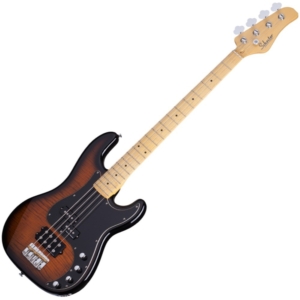 Why do bass guitars even exist? Why not just use an electric guitar and just use the lowest four notes?
This has been answered pretty well on Quora but I wanted to add my two cents.
A while ago, a friend was kind enough to loan me (thanks Chuck!) a Schecter Diamond Series (pictured here) electric bass.
I have been playing guitar for most of my life but this thing is just magical. You have to listen so much more closely when playing bass than guitar, I think partly because of all the frequencies under your hand. It seems like so much more is available than on a guitar string, typically.
You’ll hear “start with the 1 and 5” and that works fine but if you listen to a bassist who really knows the neck, they carve up chords like a horn player. You could spend a LOT of time getting this under control. It’s really only nominally a guitar if you think about it, in the same way that a ukulele is, imho.
I hope this is helpful and I highly recommend, if you’re a guitar player, putting your hands on a bass guitar if you get the chance. Or even if you’re not a guitar player!
How many bass players does it take to change a lightbulb? Only one, but the […]
Why are all the strings used if you only need three notes?
When all the strings of the guitar are played at once, why does it form a harmonious chord even though only 3-4 of the strings make up the original chord?
It’s because of the voicing. “Voicing” is how chords are organized, as they sound different depending on which notes are on the bottom and which are above.
For instance if you play a hand-friendly, top-of-the-neck E major chord, you’ve got two open E strings and a finger on the second fret of the D string, so that’s three E’s! Plus your G# which you need for the 3rd and 2 Bs (the 5th), That voicing for an E major sounds so full and rich because that voicing has a bunch of overtones from playing the root note (the E). and one of the amazing, beautiful things about a guitar is that you can play the same chord in a ton of different places! You can take advantage of the different voicing each position can offer.
Keep experimenting & have fun!
“I believe every guitar player inherently has something unique about their playing. They just have to identify what makes them different and develop it.” – B.B. King
What are the 4 types of musical instruments?
These are the four types of musical instruments, as far as I can tell:
First comes Guitar. That is the first and primary category of musical instruments, of course, and the only one that a reasonable person should consider.
Following that there are things that are not guitars but sort of guitar-ish. Ukuleles and basses, banjos, dulcimers, lutes, etc., all fall in this category.
Third would be instruments that have strings but are otherwise, not at all guitar-like. You could lump pianos, kalimbas, harps and all that sort of non-guitar foolishness in that category.
Lastly comes instruments that are not remotely like guitars at all. They have no strings and they rely on, if you can believe it, having air blown into them, being plugged into an electrical outlet or being pounded on with wooden sticks to produce “music”. As far as categories of instruments, well, the last three sets of “instruments” are hardly worth a reasonable person’s attention at all.
‘course, I maybe a bit biased.