
Try thinking in numbers!
As a new Year’s resolution, how about adopting a new way of thinking about what you already do? Adopting a numeric system for understanding how to move easily around the neck might be useful for you.
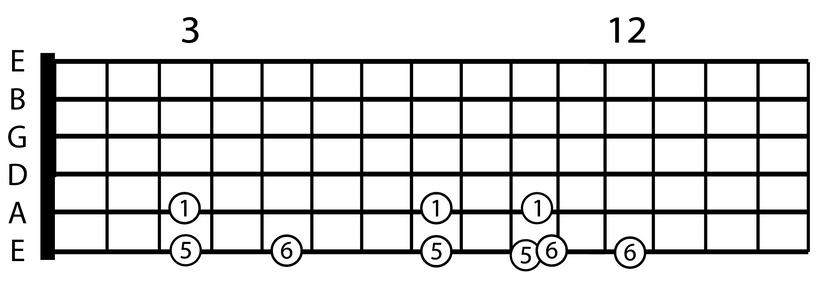
Let’s start with a core pattern that we can play over a chord progression. We can start with (1/5/6/5) played over (1/4/5) as a foundational exercise for numeric thinking.
Key Insights:
We will be using numbers to refer both to the strings (1,2,3,4,5 and 6) and the numeric value of notes in an octave (1,2,3,4,5,6,7 and 1). This can be confusing so please be patient.
The guitar’s coursed strings allows for playing the same note in multiple locations, enabling the use of identical numeric patterns in different positions.
The (1 5 6 5) pattern works on string pairs 5-6, 4-5, and 3-4. It requires adjustment on pairs with the B string (2nd string) due to its 3rd tuning interval. This probably sounds like a complex idea but the truth is, it’s pretty simple- you just need to consider the notes as numbers.
The Numeric System: A Different Framework
Our Goal: Shift from simply memorizing shapes to understanding the underlying numeric relationships note to note, and note to chord.
“Diatonic” is a useful word to understand. It simply means the notes in a major scale. We can think of them by number as 1, 2, 3, 4, 5, 6, 7, and 1 (the octave). These numbers have set intervals between them of either a whole step or half step
Diatonic: Notes naturally occurring in a major scale (e.g., C, D, E, F, G, A, B in C major).
Non-Diatonic: Notes outside the scale (e.g., B♭ in C major, which is a ♭7).
The guitar’s layout allows identical numeric patterns to be played in different positions.
Applying the Numeric System: (1/5/6/5) over (1 /4/ 5)
The Exercise: Play the (1 /5 /6 /5) note pattern over a (1 /4 /5) chord progression.
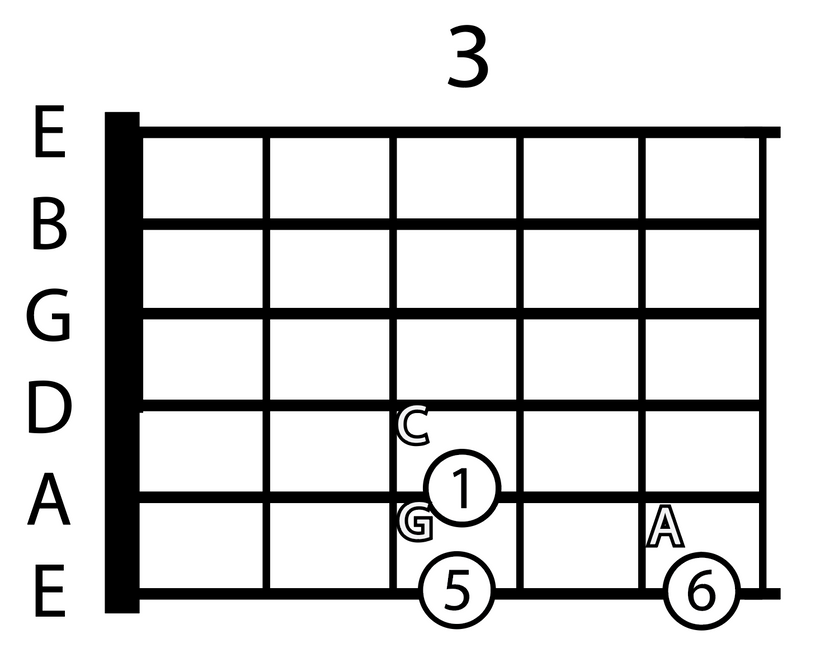
For this exercise using the pattern (1/5/6/5), we will find the one note on the 5 string.
The 5th note will be on the same fret of the adjacent 6 string. The 6 will be a whole step up (two frets)
Root Note (1): On the 5th string.
Fifth (5): On the 6th string, same fret as the root.
Sixth (6): Two frets higher on the 5th string.
Fifth (5): Back to the 6th string, same fret as the root.
Execution:
Key of C: Start the pattern with C (3rd fret, 5th string).
Move to the 4 Chord (F): Shift the entire pattern up to F (8th fret, 5th string).
Move to the 5 Chord (G): Shift the entire pattern up to G (10th fret, 5th string).
Practice Method:
Slow Down: Practice at a speed where position shifts are seamless, avoiding any breaks in rhythm.
Think Numerically: Focus on the 1-5-6-5 relationship, not the specific notes.
Universal Application Across String Pairs
The (1 5 6 5) pattern works identically on these string pairs: 5th and 6th, 4th and 5th, 3rd and 4th. The exception to the pattern is the G/B pair. Reason: The B string is tuned a half-step lower than the standard perfect fourth interval, breaking the pattern’s geometry.
Next Steps
Goal:
Execute the pattern slowly and seamlessly at any position.Focus:
Internalize the numeric relationships, not just the physical shapes.Action Items:
Practice 1-5-6-5 on 5-6, 4-5, 3-4, 1-2;
move 1-4-5 roots; slow; no gapsStretch:
Apply the pattern to other string pairs (4-5 and 3-4).
End practice sessions on the 1 chord to reinforce the concept of harmonic resolution.
Discover more from Guitar Lessons and Performance - Paul Elwood
Subscribe to get the latest posts sent to your email.