L.O.V.E.

download the l.o.v.e. leadsheet

L-O-V-E” is a song written by Bert Kaempfert and Milt Gabler, recorded by Nat King Cole for his 1965 studio album L-O-V-E.

The song was composed by Bert Kaempfert with lyrics by Milt Gabler, and produced by Lee Gillette. The trumpet solo was performed by Bobby Bryant. The song had previously appeared as an instrumental track on Kaempfert’s album Blue Midnight (1964).

For international versions of his L-O-V-E album, Nat King Cole also recorded versions of “L-O-V-E” and other songs, in Japanese (mixed with English words), Italian, German, Spanish and French. In this last language, the song was renamed “Je Ne Repartirai Pas” and translated by Jean Delleme.

English singer Joss Stone recorded a cover of “L-O-V-E” for the soundtrack to a commercial for Chanel’s Coco Mademoiselle fragrance. The ad, starring Keira Knightley and directed by Joe Wright, debuted on September 24, 2007, on E!, Bravo, and VH1.

Stone’s version was released digitally on September 18, 2007, reaching number 100 on the UK singles chart and number 75 on the Swiss Hitparade. It was later included as a bonus track on the deluxe version of her third studio album, Introducing Joss Stone (2007), […]

2026-05-02T13:32:38-04:00

In My Room

Download the sheet music PDF:

“In My Room” is a song written by Brian Wilson and Gary Usher for the American rock band the Beach Boys. It was released on their 1963 album Surfer Girl. It was also released as the B-side of the “Be True to Your School” single. The single peaked at number 23 on the US Billboard Hot 100 (the A-side peaked at number 6, for a two-sided top-40) and was eventually inducted into the Grammy Hall of Fame in 1999. “In My Room” was ranked number 212 on Rolling Stone’s list of The 500 Greatest Songs of All Time.

The song is written in the key of B major and features a flat VII A major chord.

Gary Usher explained that: “In My Room” found us taking our craft a little more seriously. Brian and I came back to the house one night after playing ‘over-the-line’ (a baseball game). I played bass and Brian was on organ. The song was written in an hour … Brian’s melody all the way. The sensitivity … the concept meant a lot to him. When we finished, it was late, after our midnight curfew. In fact, Murry [the Wilson brothers’ father] came in a couple of times and wanted me to leave. Anyway, we got […]

2026-04-16T10:29:53-04:00

Hello Dolly

download the lead sheet for “hello dolly”

Hello, Dolly!” is the title song of the popular musical of the same name, with music and lyrics by Jerry Herman.

A recording by Louis Armstrong released in 1964 was a widely popular success, winning the Song of the Year and Male Vocal Performance awards at the 7th Annual Grammy Awards. Armstrong’s rendition was inducted into the Grammy Hall of Fame in 2001.

At the behest of his manager, Louis Armstrong made a demonstration recording of “Hello, Dolly!” in December 1963, for the song’s publisher to use to promote the Broadway show.

In January 1964, the same month Hello, Dolly! opened in New York City, Kapp Records released Armstrong’s publishing demo as a commercial single. His version reached No. 1 on the U.S. Billboard Hot 100, ending the Beatles’ streak of 3 chart-topping hits in a row over 14 consecutive weeks.

Never being able to master the guitar is both the worst thing and the best thing about guitar.

2026-05-04T12:12:59-04:00

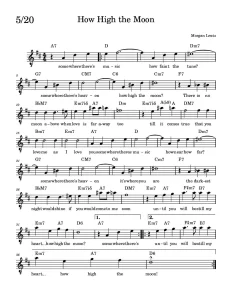
How High The Moon

how high the moon lead sheet

How High the Moon” is a jazz standard with lyrics by Nancy Hamilton and music by Morgan Lewis. It was first featured in the 1940 Broadway revue Two for the Show, where it was sung by Alfred Drake and Frances Comstock.

The earliest recorded hit version was by Benny Goodman & His Orchestra, featuring vocalist Helen Forrest. It was recorded on February 7, 1940, and released by Columbia Records as catalog number 35391, with the flip side “Fable of the Rose”. The Les Paul Trio recorded a version released as V-Disc 540B with a spoken introduction which was issued in November 1945 by the U.S. War Department. In 1948, bandleader Stan Kenton enjoyed some success with his version of the tune. The recording, with a vocal by June Christy, was released by Capitol Records as catalog number 911 (with the flip side “Willow, Weep for Me”) and 15117 (with the flip side “Interlude”). It reached the Billboard magazine Best Seller chart on July 9, 1948, its only week on the chart, at #27.

A recording of the song by Les Paul and Mary Ford was made on January 4, 1951, in their apartment’s home studio in Jackson Heights, Queens. This version featured Paul on all […]

2026-04-16T14:05:24-04:00

Dream Lover

download a pdf chord and lyric sheet here
“Dream Lover” is a song written by American musician Bobby Darin. Darin recorded his composition on March 5, 1959 and released it as a single the following month. It was produced by Ahmet Ertegun and Jerry Wexler and engineered by Tom Dowd.

In addition to Darin’s vocal, the song features Neil Sedaka on piano. While recording it Darin decided to stretch out some chord changes he found on the piano and add strings and voices. A picture sleeve, featuring a portrait of Darin, was also issued for this record in the U.S.

“Music brings a warm glow to my vision, thawing mind and muscle from their endless wintering.” – Haruki Murakami

2026-04-15T07:50:14-04:00

Beyond The Sea

Beyond the Sea

“Beyond the Sea” has been recorded by many artists, but Bobby Darin‘s version released in late 1959 is the best known, reaching No. 6 on the Billboard Hot 100, No. 15 on the US R&B Chart, No. 7 in Canada (co-charted with “That’s The Way Love Is”), and No. 8 in the UK Singles Chart in early 1960.

Before Bobby Darin’s version, two instrumental recordings reached the Top 40 of the Billboard Hot 100. Benny Goodman‘s version charted in 1948, and was featured in the Cary Grant/Betsy Drake romantic comedy Every Girl Should Be Married. Roger Williams’ recording reached No. 37 in 1955.

The first recording of “Beyond the Sea” was by Harry James and His Orchestra on December 22, 1947, and the first recording of “La Mer” was by French musician Roland Gerbeau in December 1945 (the song’s author, Charles Trenet, did not record it until the following year).

American R&B singer George Benson recorded an R&B version of the song under the title “Beyond the Sea (La Mer)”. It was released on Warner Bros. This version entered the UK Singles Chart on 20 April 1985. It peaked at No. 60 and remained on the chart for three weeks.

“The only love affair I have ever had was with music.” – Maurice Ravel

2026-04-13T11:57:05-04:00

Moon River

Moon river

Moon River” is a song composed by Henry Mancini with lyrics by Johnny Mercer. It was originally performed by Audrey Hepburn in the 1961 film Breakfast at Tiffany’s, winning an Academy Award for Best Original Song. The song also won the 1962 Grammy Awards for Record of the Year and Song of the Year. In 1999, Mancini’s recording was inducted into the Grammy Hall of Fame.

The song has been recorded by many other artists. It became the theme song for Andy Williams, who first recorded it in 1962 (and performed it at the Academy Awards ceremony that year). He sang the first eight bars of the song at the beginning of each episode of his eponymous television show and named his production company and venue in Branson, Missouri, after it; his autobiography is called “Moon River” and Me. Williams’ version was included in a LP that he recorded for Columbia on a hit album of 1962, Moon River and Other Great Movie Themes. In 2022, Williams’ rendition of the song was selected for preservation in the Library of Congress.

The song’s success was responsible for relaunching Mercer’s career as a songwriter, which had stalled in the mid-1950s because rock and roll had replaced jazz standards as the popular music of the time. The […]

2026-04-20T15:36:56-04:00

People are Strange

“People Are Strange” is a song by the American rock band the Doors. It appears on the band’s second studio album, Strange Days, released in September 1967. The song was written by the Doors’ vocalist Jim Morrison and guitarist Robby Krieger, although all of the band are credited on the sleeve notes.

The track was first released with “Unhappy Girl” as the B-side. It peaked at number 12 on the Billboard Hot 100 chart.The song’s composition started in early 1967. According to Doors drummer John Densmore, he and guitarist Robby Krieger, who had then been roommates, were visited by Jim Morrison who appeared to be “deeply depressed”. At Krieger’s suggestion, they took a walk along Laurel Canyon in the Hollywood Hills area of Los Angeles. Morrison returned from the walk “euphoric” with the early lyrics of “People Are Strange”. Intrigued by the lyrics, Krieger was convinced that the song was a hit upon hearing the vocal melody:

Morrison said “Yeah, I feel really good about this one. It just came to me all of a sudden … in a flash – as I was sitting up there on the ridge looking out over the city.” His eyes were wild with excitement. “I scribbled it down as fast as I could. It felt great to be writing again.” […]

2026-04-13T12:08:34-04:00

Dream Dream Dream

Download the PDF: Dream Dream Dream

The best-known version was recorded by the Everly Brothers at RCA Studios Nashville and released as a single in April 1958. It was recorded by them in only two live takes on March 6, 1958, and features Chet Atkins on guitar. It was the only single ever to be at number one on all of the Billboard singles charts simultaneously. On May 12, 1958, it became number one on the “Best Sellers in Stores” chart, then it reached number one on the “Most played by Jockeys” and “Top 100” charts on May 19, 1958, and remained at the top on each chart for four, five, and three weeks, respectively. With the August 1958 introduction of the Billboard Hot 100 chart, the song ended the year at number two. “All I Have to Do Is Dream” also hit number one on the rhythm and blues chart, and became the Everly Brothers’ third chart topper on the country chart. The Everly Brothers briefly returned to the Hot 100 in 1961 with this song.

Outside the United States, “All I Have to Do Is Dream” had massive success in various countries, most notably the United Kingdom, where it topped the UK’s New Musical Express chart in June 1958 and remained there for seven weeks (including one week […]

2026-04-25T19:25:50-04:00

Turn The Page

turn the pageDownload the PDF

Turn the Page” is a song by American singer Bob Seger written in 1972 and included on his Back in ’72 album in 1973. It was not released as a single until Seger’s live version of the song on the 1976 Live Bullet album got released in Germany and the UK. The song became a mainstay of album-oriented rock radio stations, and still gets significant airplay on classic rock stations.

“Turn the Page” is about the emotional and social ups and downs of a rock musician’s life on the road. Seger wrote it in 1972 while touring with Teegarden & Van Winkle. Drummer David Teegarden (of Teegarden & Van Winkle and later the Silver Bullet Band) recalls:

We had been playing somewhere in the Midwest, or the northern reaches, on our way to North or South Dakota. [Guitarist] Mike Bruce was with us. We’d been traveling all night from the Detroit area to make this gig, driving in this blinding snowstorm. It was probably 3 in the morning. Mike decided it was time to get gas. He was slowing down to exit the interstate and spied a truck stop. We all had very long hair back then – it was the hippie era – but Skip, Mike […]

2026-04-13T14:15:34-04:00
Go to Top