Taylor Guitar saved my life
My Taylor 214ce, which attributes include playability, beautiful tonality and a lifesaving device.


My Taylor 214ce, which attributes include playability, beautiful tonality and a lifesaving device.
Hey_Jude part 1 lesson with Tabs
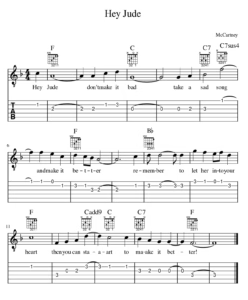 This video and chart can help you play the melody of “Hey Jude” in the first position. Set your fingers for each chord as the chord charts indicate. Being deliberate about where your fingers go is pretty important for moving ahead with guitar playing! Be patient and enjoy your progress… and your success!
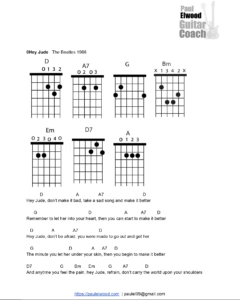 Download chord/lyrics guitar PDF
How to play “Hey Jude” on guitar. This is a great tune for solo guitar and vocal accompaniment! And it’s not too hard to get under your hand. Hey Jude! The Beatles 1968. The song’s original title was “Hey Jules“, and it was intended to comfort Julian from the stress of his parents’ separation. McCartney said, “I knew it was not going to be easy for him”, and that he changed the name to “Jude” “because “I thought that sounded a bit better”.
I think people who create and write, it actually does flow-just flows from into their head, into their hand, and they write it down. It’s simple.
Paul McCartney
“Stand by Me” is a song originally recorded by American singer-songwriter Ben E. King in 1961, and written by him, along with Jerry Leiber and Mike Stoller, who together used the pseudonym Elmo Glick. According to King, the title is derived from, and was inspired by, a spiritual written by Sam Cooke and J. W. Alexander called “Stand by Me Father”, recorded by the Soul Stirrers with Johnnie Taylor singing lead.
“Stand by Me” was featured on the soundtrack of the 1986 film Stand by Me, and a corresponding music video, featuring King along with actors River Phoenix and Wil Wheaton, was released to promote the film. The song was also featured in a 1987 European commercial of Levi’s 501 jeans, contributing to greater success in Europe. In 2012, its royalties were estimated to have topped $22.8 million (£17 million), making it the sixth highest-earning song of its era. Fifty percent of the royalties were paid to King. In 2015, King’s original version was inducted into the National Recording Registry by the Library of Congress, as “culturally, historically, or aesthetically significant”,[4] just under five weeks before his death. Later in the year, the 2015 lineup of the Drifters recorded it in tribute.
There have been over 500 recorded versions of the song,
nobody_knows_you_when_you_re_down_and_out 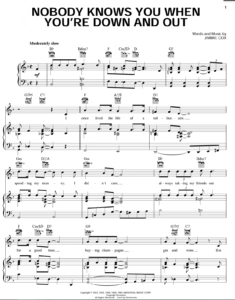 Chord/lyric sheet
“Nobody Knows You When You’re Down and Out” is a blues standard written by pianist Jimmie Cox in 1923 and originally performed in a Vaudeville-blues style. The lyrics in the popular 1929 recording by Bessie Smith are told from the point of view of somebody who was once wealthy during the Prohibition era and reflect on the fleeting nature of material wealth and the friendships that come and go with it. Since her 1929 recording, the song has been interpreted by numerous musicians in a variety of styles.
“Music is the great uniter. An incredible force. Something that people who differ on everything and anything else can have in common.” – Sarah Dessen
When Irish Eyes are Smilin’ guitar chords ”
”
When Irish Eyes Are Smiling” is a lighthearted song in tribute to Ireland. Its lyrics were written by Chauncey Olcott and George Graff, Jr., set to music composed by Ernest Ball, for Olcott’s production of The Isle O’ Dreams, and Olcott sang the song in the show. It was first published in 1912, at a time when songs in tribute to a romanticised Ireland were very numerous and popular both in Britain and the United States. During the First World War the famous tenor John McCormack recorded the song.
The song continued to be a familiar standard for generations. Decades later it was used as the opening song on the American radio show Duffy’s Tavern. The song has been recorded on over 200 singles and albums and by many famous singers, including Bing Crosby, Connie Francis, and Roger Whittaker.
“There are a million things in music I know nothing about. I just want to narrow down that figure.” – Andre Previn
Help me make it through the night chords and lyrics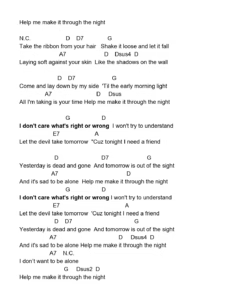
Help Me Make It Through the Night” is a country ballad written and composed by Kris Kristofferson and released on his 1970 album Kristofferson. It was covered later in 1970 by Sammi Smith, on the album Help Me Make It Through the Night. In 1982, Kris did a re-recording with Brenda Lee for the compilation album The Winning Hand. It has been covered since by many other artists from Tammy Wynette and Johnny Cash to Elvis Presley, Joan Baez, Bryan Ferry, Mark Eitzel, Tyler Childers and Engelbert Humperdinck also as a duet between Michael Bublé and Loren Allred.
Smith’s recording of the song (in May 1970) remains the most commercially successful, and best-known, version in the United States. Her recording ranks among the most successful country singles of all time in terms of sales, popularity, and radio airplay. It topped the country singles chart, and was also a crossover hit, reaching number eight on the U.S. pop singles chart. “Help Me Make It Through The Night” also became Smith’s signature song.
In May 2024, Rolling Stone ranked […]
 lean on me chords tabs and lyrics part 1
“Lean on Me” is a song written and recorded by American singer-songwriter Bill Withers. It was released in April 1972 as the first single from his second album, Still Bill. It was a No. 1 single on both the soul and Billboard Hot 100 charts, the latter chart for three weeks in July 1972. Billboard ranked it as the No. 7 song of 1972.
Numerous other versions have been recorded, and it is one of only nine songs to have reached No. 1 on the Billboard Hot 100 with versions recorded by two different artists with a 1987 cover by Club Nouveau also reaching No. 1.In 2007, the 1972 recording of the song by Bill Withers on Sussex Records was inducted into the Grammy Hall of Fame. It was ranked No. 208 on Rolling Stone‘s list of “The 500 Greatest Songs of All Time” in 2010.
 the Elegant Corpse notation and chords
Here’s a friendly nod to Tim Burton and Danny Elfman in 32 measures.
“Mournful and yet grand is the destiny of the artist.” – Franz Liszt
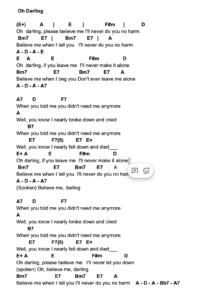 Download the chord and lyric sheet here!
“Oh! Darling” is a song by the English rock band the Beatles, appearing as the fourth song on their eleventh studio album Abbey Road (1969). It was written primarily by Paul McCartney and credited to Lennon–McCartney. Its working title was “Oh! Darling (I’ll Never Do You No Harm)”. Although not issued as a single in either the United Kingdom or the United States, a regional subsidiary of Capitol successfully edited it as a single in Central America, having “Maxwell’s Silver Hammer” as its B-side. It was also issued as a single in Portugal. Apple Records released “Oh! Darling” in Japan with “Here Comes the Sun” in June 1970.
McCartney later said of recording the track, “When we were recording ‘Oh! Darling’ I came into the studios early every day for a week to sing it by myself because at first my voice was too clear. I wanted it to sound as though I’d been performing it on stage all week.” He would only try the song once each day; if it was not right he would wait until the next day. According to sound engineer Alan Parsons, McCartney once lamented […]

