How to play “Your Song”
How to play “Your Song” Elton John – fingerstyle guitar. A beautiful song, and not too hard to get the melody right out of the chord shapes.


How to play “Your Song” Elton John – fingerstyle guitar. A beautiful song, and not too hard to get the melody right out of the chord shapes.
If you’re looking for online guitar lessons, I might be just the right teacher for you! I work with guitarists and ukulele players of all levels and abilities and I have students from all over!
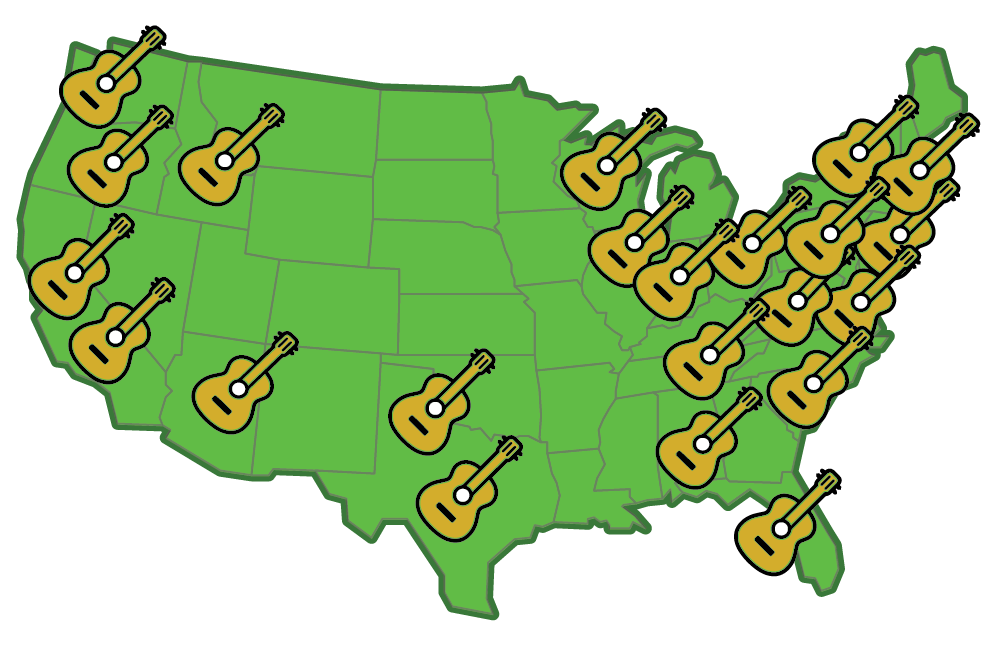 Online students from across the country!
To make sure I am a good fit for you, I offer a free initial online lesson. No matter what level you are playing at now, I’m willing to bet my own time that you’ll benefit from online lessons with me- and you’ll discover that yourself at your first FREE lesson!
Simply schedule your free lesson for yourself here. The online scheduling tool is quite easy to use; simply choose “First Free Lesson” from the lesson choices and select the day and time you are interested in. If you see a time listed in the scheduler, that time is available for us to meet.
I’m looking forward to meeting you soon!
Paul

“Muddy Waters meets Tiny Tim”, as my friend and teacher John LaGreca said. This blues will be in Am. Using a 1/4/5 pattern, that gives us Am for the 1, D, for the 4 and E for the 5.
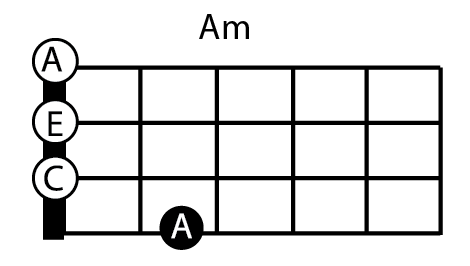
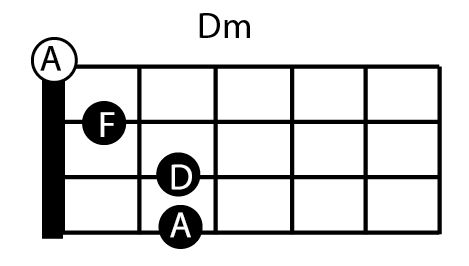
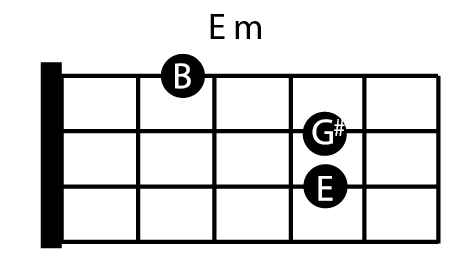
We can play a typical 12 bar blues pattern
like this:
The 12th measure with the 5 chord is the “turnaround”.
We can use our pentatonic minor scale to play over the chords! The minor pentatonic scale uses the 1, b3, 4, 5 and b7 notes. for Am that would be A, C, D, E and G and that works great for the 1 and 4 chords. We can also use the “blue” note (b5) to make it sound cooler.
For the 5 chord, we’ll use the pentatonic for E. Again, 1, b3, 4, 5 and b7, o that will be E, G, A, B and D. The b5 in this scale is a Bb.
You can use any note as a “passing” note though, as long as you are heading to a chord tone! […]
“Muddy Waters meets Tiny Tim”, as my friend and teacher John LaGreca said. This blues will be in Am. Using a 1/4/5 pattern, that gives us Am for the 1, D, for the 4 and E for the 5.
We can play a typical 12 bar blues pattern
like this:
The 12th measure with the 5 chord is the “turnaround”.
We can use our pentatonic minor scale to play over the chords! The minor pentatonic scale uses the 1, b3, 4, 5 and b7 notes. for Am that would be A, C, D, E and G and that works great for the 1 and 4 chords. We can also use the “blue” note (b5) to make it sound cooler.
For the 5 chord, we’ll use the pentatonic for E. Again, 1, b3, 4, 5 and b7, o that will be E, G, A, B and D. The b5 in this scale is a Bb.
You can use any note as a “passing” note though, as long as you are heading to a chord tone! […]
The chord namer will automatically name a chord shape (if a valid chord shape is supplied.) Simply select the circles on the fret board that correspond to where your fingers go and hit “Go”. A few things to watch out for:
Strings that aren’t strummed should be set to “Mute” and open strings should be set to zero.
Don’t enter your chord upside-down! The fretboard is shown with the lowest pitch string at the bottom and the highest pitch string at the top (unless you’ve tuned your instrument differently.)
If there is more than 1 way to name the chord you supplied, the chord namer will give you multiple results. They are all correct but which one you choose may depend on the context it is used in. Visit chord namer here!
1: C Major scale, first position. Everything you need is right there and it’s easy to spell.
2: C Major scale on the the A string, ditto- and you can start to see how the neck works (incidentally you’ve just played “Joy to the World” backward so that’s a bonus).
3: Hand-friendly C chord which is the 1 chord for C. You’ve heard of 1, 4 and 5 chords; a ton of folk, rock, country and bluegrass tunes use these chords, and the C is a great place to start.
4: Hand-friendly F chord which is the 4 chord for C. F is tricky but you can play it in a bunch of ways right at the top of the neck so no worries if you can’t make a barre chord yet, you can get away with a three-finger F chord by playing F, A and C notes. Keep at it.
5: Hand-friendly G chord, which is the 5 for C so a ton of folk, rock, country tunes- pick your poison.
6: D chord, using the open D string. You can ignore the 5 and 6 strings and make a triangle on the 1,2 and 3 strings just to get started. Open string is a freebie!
7: E […]
Download tabs and notation pdf
How to play “La Vie en Rose” fingerstyle on ukulele.
“La Vie en rose“ (French for ‘Life in pink’; pronounced [la vi ɑ̃ ʁoz]) is the signature song of French singer Édith Piaf, written in 1945, popularized in 1946, and released as a single in 1947. The song became popular in the United States in 1950, when seven versions reached the Billboard charts. These recordings were made by Tony Martin, Paul Weston, Bing Crosby (recorded 22 June 1950), Ralph Flanagan, Victor Young, Dean Martin, and Louis Armstrong.
A version in 1977 by Grace Jones was also an international hit.
The song’s title can be translated as “Life in happy hues”, “Life seen through rose-coloured glasses”, or “Life in rosy hues”; its literal meaning is “Life in Pink.”
The lyrics of the song were written by Piaf, with music composed by Louiguy, and is registered with SACEM. It was probably Robert Chauvigny who completed the music. When Piaf suggested to Marguerite Monnot that she sing the piece, the latter rejected “that foolishness.” It was eventually Louiguy who accepted authorship of the music. The song was broadcast live before […]
Navajo rug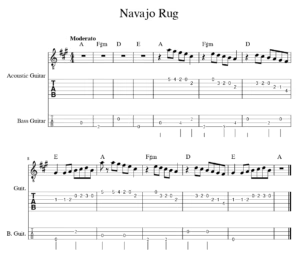
A rhythm guitar and drum track to play along with.
“Navajo Rug” is a classic western and folk song co-written by Canadian singer-songwriter Ian Tyson and American songwriter Tom Russell. Overview and History
how to play fields of athenry fingerpicking lesson part 1. A beautiful song, and not too hard to pick the melody out of the chords, or accompany yourself singing!
“The Fields of Athenry” is a song written in 1979 by Pete St. John in the style of an Irish folk ballad. Set during the Great Famine of the 1840s, the lyrics feature a fictional man from near Athenry in County Galway, who stole food for his starving family and has been sentenced to transportation to the Australian penal colony at Botany Bay. It has become a widely known, popular anthem for Irish sports supporters and those who favour a United Ireland. Enjoy!
Download the PDF notation and tab for fields of athenry here
“Flip, Flop and Fly” has an arrangement similar to Big Joe Turner’s 1954 number 1 R&B chart hit “Shake, Rattle and Roll”. Music critic Cub Koda suggests that “leftover verses [from the ‘Shake, Rattle and Roll’ recording session] were then recycled into Turner’s follow-up hit, ‘Flip, Flop and Fly.'” Both are up-tempo twelve-bar blues with a strong backbeat. “Flip, Flop and Fly” reached number 2 on Billboard magazine’s R&B chart in 1955, less than one year after “Shake, Rattle and Roll”.
Accompanying Turner on vocals are the song’s co-writer Jesse Stone on piano, Al Sears on tenor sax, Connie Kay on drums, and unidentified trumpet, alto sax, baritone sax, guitar, and bass players. Turner subsequently recorded several live versions of the song.
In 1973, a rendition by the Canadian Downchild Blues Band reached number 35 on the RPM 100 singles chart. It was the first, and highest ranked, of four songs on the Canadian charts and is included on their second album Straight Up (1974), In 1978, a rendition by the American the Blues Brothers appeared on their album Briefcase Full of Blues. In 2000, a rendition by the American Ellis Hall was used on the soundtrack of the 2000 animated comedy film, Chicken Run.
“Music comes to me more readily than words.” – Ludwig Van […]
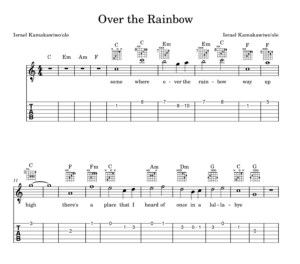
“Over the Rainbow“, also known as “Somewhere Over the Rainbow“, is a ballad by Harold Arlen with lyrics by Yip Harburg. It was written for the 1939 film The Wizard of Oz, in which it was sung by actress Judy Garland in her starring role as Dorothy Gale.
About five minutes into the film, Dorothy sings the song after failing to get Aunt Em, Uncle Henry, and the farmhands to listen to her story of an unpleasant incident involving her dog, Toto, and the town spinster, Miss Gulch (Margaret Hamilton). Aunt Em tells her to “find [her]self a place where [she] won’t get into any trouble”. This prompts her to walk off by herself, musing to Toto, “Someplace where there isn’t any trouble. Do you suppose there is such a place, Toto? There must be. It’s not a place you can get to by a boat, or a train. It’s far, far away. Behind the moon, beyond the rain”, at which point she begins singing.
“Over the Rainbow” won the Academy Award for Best Original Song and became Garland’s signature song. It has been included in several all-time lists, and has […]