About Paul

This author has not yet filled in any details.
So far Paul has created 331 blog entries.

How to play dire wolf

looking for online guitar lessons? First one is free!

How to play dire wolf.

In the timbers of Fennario, the wolves are running round
The winter was so hard and cold, froze ten feet ‘neath the ground
Don’t murder me, I beg of you, don’t murder me
Please, don’t murder me
I sat down to my supper, ’twas a bottle of red whisky
I said my prayers and went to bed, that’s the last they saw of me
Don’t murder me, I beg of you, don’t murder me
Please, don’t murder me
When I awoke, the Dire Wolf, six hundred pounds of sin
Was grinning at my window, all I said was come on in
Don’t murder me, I beg of you, don’t murder me
Please, don’t murder me
The Wolf came in, I got my cards, we sat down for a game
I cut my deck to the Queen of Spades, but the cards were all the same
Don’t murder me, I beg of you, don’t murder me
Please, don’t murder me
Don’t murder me
In the backwash of Fennario, the black and bloody mire
The Dire Wolf collects his dues, while the boys sing ’round the fire
Don’t murder me, I beg of you, don’t murder me
Please, don’t murder me
Don’t murder me
I beg of you don’t murder me
Please, don’t murder me
No no no don’t murder me
I beg of you, don’t murder me
Please, don’t murder me
Please, […]
2026-03-09T18:20:41-04:00

Hobo Song


Hobo life was dangerous. Itinerant, poor, far from home and support, hobos also faced the hostility of many train crews and the railroad police, nicknamed “bulls”, who often dealt violently with trespassers. British poet W. H. Davies, author of The Autobiography of a Super-Tramp, lost a foot when he fell under the wheels trying to jump aboard a train. It was easy to get trapped between cars, and one could freeze to death in cold weather. When freezer cars were loaded at an ice factory, any hobo inside was likely to be killed.

Around the end of World War II, railroads began to move from steam to diesel locomotives, making jumping freight trains more difficult due to higher speeds and less frequent stops. This, along with postwar prosperity, led to a decline in the number of hobos. In the 1970s and 1980s hobo numbers were augmented by returning Vietnam War veterans, many of whom were disillusioned with settled society. Overall, the national economic demand for a mobile surplus labor force has declined over time, leading to fewer hobos.

Lyrics & music by Jack Bonus

Too late to feel sorrow Too late to feel pain
He’s just an old hobo And he’s Lost out in the rain

He’d never cause trouble. So don’t have no fear
He’s just an old hobo And […]

2026-03-19T08:17:47-04:00

How to play Gentle on my mind

How to play gentle on my mind. This part 1 lesson is for solo guitar fingerstyle and includes tablature

How to play “Gentle on my mind” fingerstyle guitar.

tab for Gentle on my mind

“Gentle on My Mind” is a song that was written and originally recorded by John Hartford, and released on his second studio album, Earthwords & Music (1967). Hartford composed the song after watching Doctor Zhivago in 1966, as he was inspired by the film and his own personal experiences. The lyrics describe the reminiscences of lost love of a man as he travels through the country. The following year, Hartford released the song as a single on RCA Records.

It then caught the attention of Glen Campbell, who recorded his cover version with a group of session musicians known as the Wrecking Crew. Campbell’s cover of “Gentle on My Mind” peaked in the top 30 on Billboard’s Hot Country Singles chart. In 1968, between Campbell’s and Hartford’s recordings, the song earned four Grammy Awards. It ended up being popularized by Campbell, whose version became by 2001 the second-most-played song on the radio in the United States.

“Chord substitution isn’t some mysterious religious sect.” – Howard Roberts

looking for online guitar lessons? First one is free!

2026-03-10T11:46:16-04:00

Deep Elem Blues


How to play deep elem blues

(also spelled “Deep Elem Blues” or “Deep Ellum Blues”) on solo guitar. Deep elem blues is an American traditional song. The title of the tune refers to the historical African-American neighborhood in downtown Dallas, Texas. Known as Deep Ellum, this was home to music legends Blind Lemon Jefferson, Blind Willie Johnson, Lead Belly, and Bill Neely. This is a great tune to get started with blues.

history

The first known recording was made by the Cofer Brothers in 1923 under the band name the Georgia Crackers. The title was “The Georgia Black Bottom” on OKeh Records (OKeh 45111). The song alluded to the dance craze called Black Bottom of the 1920s which in part referenced the community of Black Bottom, Detroit. The change from Black Bottom to Deep Elm occurred sometime between 1926 and 1933.

The Shelton Brothers recorded various versions of this song, the first being cut in 1933 with Leon Chappelear under the pseudonym of Lone Star Cowboys for Bluebird Records. They recorded it again in 1935 for Decca Records followed by “Deep Elm No.2” and “Deep Elm No.3”. Les Paul (as Rhubarb Red) recorded “Deep Elem Blues” and “Deep Elem Blues #2” on Decca in 1936. The Sheltons also recorded it in the 1940s as “Deep Elm Boogie” for King Records.

other versions

Other versions of the song were made between […]

2026-03-12T17:35:25-04:00

Scotch and Soda

How to play scotch and soda on guitar, A stand-up member of the great american song book with a mysterious past. Lead sheet here

This great Kingston Trio song “Scotch and Soda” was discovered by the Trio through the parents of the baseball player Tom Seaver, who had first heard it in a hotel piano lounge in 1932 when on their honeymoon in Phoenix, Arizona. They liked it so much that they had the piano player write it down for them so it would be “their song.” One member of the trio (Dave Guard) was dating Seaver’s older sister (Katie) at that time, and heard the song on a visit to the Seaver home. Although it is credited to Guard (he had it copyrighted in his name on March 30, 1959), the trio never discovered the real songwriter’s name, though they searched for years.

Here’s Scotch and Soda by the Kingston Trio:

“To be creative and spontaneous, you have to live with imperfection.” – John Abercrombie

2026-03-09T18:21:13-04:00

Blowin’ in the wind


Blowin_in_the_Wind

“Blowin’ in the Wind” is a song written by Bob Dylan in 1962. It was released as a single and included on his album The Freewheelin’ Bob Dylan in 1963. It has been described as a protest song and poses a series of rhetorical questions about peace, war, and freedom. The refrain “The answer, my friend, is blowin’ in the wind” has been described as “impenetrably ambiguous: either the answer is so obvious it is right in your face, or the answer is as intangible as the wind”

In 1994, the song was inducted into the Grammy Hall of Fame. In 2004, it was ranked number 14 on Rolling Stone magazine’s list of the “500 Greatest Songs of All Time”.

Dylan originally wrote and performed a two-verse version of the song; its first public performance, at Gerde’s Folk City on April 16, 1962, was recorded and circulated among Dylan collectors. Shortly after this performance, he added the middle verse to the song. Some published versions of the lyrics reverse the order of the second and third verses, apparently because Dylan simply appended the middle verse to his original manuscript, rather than writing out a new copy with the verses in proper order. The song was published for the first time in May 1962, in the sixth issue of Broadside, […]

2026-03-10T11:46:36-04:00

how to play till there was you

How to play Till there was you. Tabs, chords notation and lyrics:

Till there was you

Till There Was You” is a show tune written in 1950 by Meredith Willson, originally entitled “Till I Met You.” It was originally recorded October 25, 1950, by Meredith Willson & his Orchestra and Eileen Wilson. The song was retitled and used in his musical play The Music Man (1957), and which also appeared in the 1962 movie version. It is sung by librarian Marian Paroo (performed by Barbara Cook on Broadway, and by Shirley Jones in the film) to “Professor” Harold Hill (portrayed on Broadway and in the film by Robert Preston) toward the end of Act Two.

In 1959, the song became the first of four US Top 40 hits for Anita Bryant. “Till There Was You” was covered by the Beatles in 1963.

“The song of rejoicing softens hard hearts. It makes tears of godly sorrow flow from them. Singing summons the Holy Spirit. Happy praises offered in simplicity and love lead the faithful to complete harmony, without discord. Don’t stop singing.” – Hildegard von Bingen

2026-03-10T16:25:14-04:00

Blues Guitar


Regular Folks Playing Guitar: Blues Guitar

Blues guitar is great fun and pretty simple once you understand the scale numbers! The video above is an example of following a backing track and playing blues scale notes over the top as a melody line. You can hear how the chord tones and blues notes work with passing notes to create a cool bluesy-sounding melody. Once you understand the numbers and the target chords, it’s almost impossible to make a mistake! Click the chart to download a printable PDF instruction sheet For E major, minor pentatonic and blues in the first position. And there’s a Zeppelin lick for you there too. E-penta-major-and-blues

Lovers have come and gone, but only my mistress stays. She is beautiful and gentle. She is a swinger. She has grace. To hear her speak, you can’t believe your ears. She is ten thousand years old. She is as modern as tomorrow, a brand new woman every day. Music is my mistress, and she plays second fiddle to no one.   –  Duke Ellington

Next:

2026-03-10T07:11:38-04:00

Building major chords from the 5 string


Regular Folks Playing Guitar: Build a major chord from the 5th string

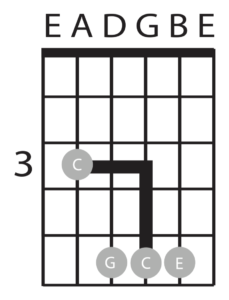
It’s handy to be able to build chords from the 5th string! Let’s talk about C in the first position as an example.

When you make a C chord – usually this is the first way we learn how to play it- the notes that make up the chord, just using the 4 inside strings are C, E,G and C again. “CEG” spells C major because those are the 1st 3rd and 5th notes of the C scale. We can play those notes in combination in lots of places on the neck of the guitar and another way to do it allows the shape to be “portable” – that is, we can use the same chord shape anywhere up and down the neck.

Start with your first finger on the 3rd fret of the A string – That’s your C. now 2nd finger on the 5th fret of D gives you a G, the 5th note of the C scale. 3rd finger on the G string gives you a C again, and pinkie on the 5th fret of B gives you and […]

2026-03-10T11:46:57-04:00

C scale in the first position


Regular Folks Playing Guitar: C scale in the first position

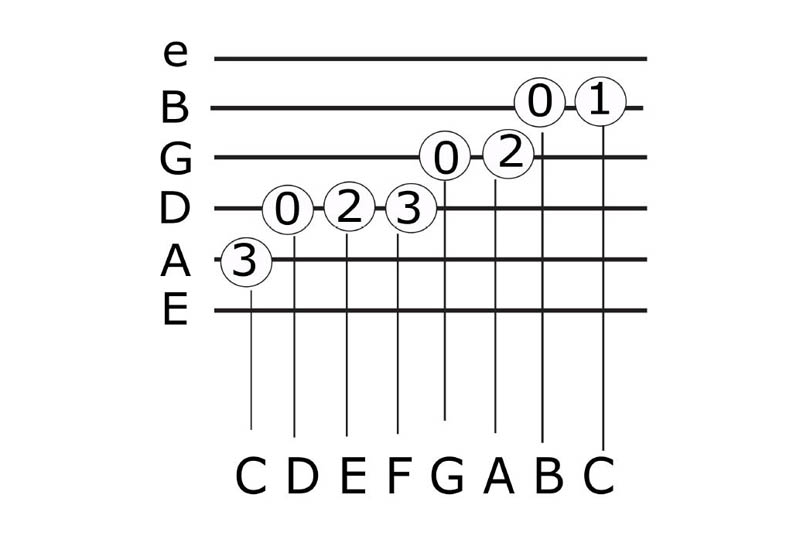
This is usually the first scale we learn because it’s easy to spell- no sharps or flats! And we can play it with open string notes. Follow the pdf carefully and remember to use the correct finger on the correct fret. First finger, first fret, second finger, second fret, third finger, third fret, fourth finger, fourth fret.

The video above shows not just one octave but all the C scale notes in the first position. You’ll notice that I name the notes in a few different ways- by their name, by their fret position and by their scale degree. You can also name the notes by their intervals! It is useful to think of scale notes in a few different ways. Believe it or not, all notes are related in some way and knowing a couple of different ways to think about them helps us understand the relationships better. c scale open strings

A downloadable chart of t

2026-03-10T11:47:27-04:00
Go to Top