About Paul

This author has not yet filled in any details.
So far Paul has created 354 blog entries.

Nearness Of You

“Nearness Of You”, Hoagy Carmichael in F at 95 BPM. PDF chord sheet linked below.

Download “Nearness Of You” PDF

The Nearness of You” is a popular song written in 1937 by Hoagy Carmichael, with lyrics by Ned Washington. Intended for an unproduced Paramount Pictures film titled Romance In The Rough, the studio’s publishing division Famous Music reregistered and published the song three years later in 1940. It was first recorded by Chick Bullock and his Orchestra on Vocalion.

The song was also heard in the later 1940 recording “In the Mood” by Glenn Miller and His Orchestra, with vocals by Ray Eberle. Later in the 1940s and the early 1950s, many other artists covered the song, including George ShearingSarah VaughanCharlie ParkerGerry MulliganBob Manning, and a duet version by Louis Armstrong with Ella FitzgeraldJames Taylor joined Michael Brecker for a pop/jazz version on Brecker’s 2000 album Nearness of You: The Ballad Book. Two years later, the song closed the Grammy Award–winning album Come Away with Me by Norah Jones.

“Music lives and breathes to tell us who we are and what we face. It is a path […]

2026-04-19T08:41:56-04:00

Thinking In Numbers

Looking for a nifty New Year’s guitar-playing resolution?

Try thinking in numbers!

As a new Year’s resolution, how about adopting a new way of thinking about what you already do? Adopting a numeric system for understanding how to move easily around the neck might be useful for you.

Let’s start with a core pattern that we can play over a chord progression. We can start with (1/5/6/5) played over (1/4/5) as a foundational exercise for numeric thinking.

Key Insights:

We will be using numbers to refer both to the strings (1,2,3,4,5 and 6) and the numeric value of notes in an octave (1,2,3,4,5,6,7 and 1). This can be confusing so please be patient.

The guitar’s coursed strings allows for playing the same note in multiple locations, enabling the use of identical numeric patterns in different positions.

The (1 5 6 5) pattern works on string pairs 5-6, 4-5, and 3-4. It requires adjustment on pairs with the B string (2nd string) due to […]

2026-03-09T15:44:36-04:00

Caught somewhere in time

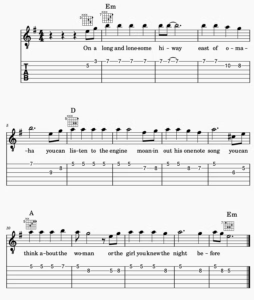
introduction. This piece speaks to our focus on the Em scale, which is the relative minor for G. You can consider this tune to be written in either G or Em, as they both have one sharp.

The G major scale: G. A. B. C. D. E. F#. G
1.  2.  3.  4. 5. 6.  7.   8/1

If you check the intervals you’ll see that this follows the pattern of WWHWWWH

Now, if we leave the scale as-is and shift the beginning note to the 6th degree (E) something wonderful happens. We are playing the relative minor of the G Major scale, so starting and ending at 6. This is the pattern for playing any scale modally, btw- play the scale, starting and ending on a number other than 1. Here we start on 6 (E) and that gives us the relative minor.

1-2: whole step
2-3: half step
3-4: whole step
4-5: whole step
5-6: half step
6-7: whole step
7-8: whole step

E  F# G  A B  C D E
6.  7.  1. 2. 3. 4. 5. 6

See? All we did was to start counting from 6 instead of one. The intervals are the same. They don’t change, only the note we start on. This is the 6th mode of a major scale, also called the “Aeolian” mode. Very handy for rock music based in classical theory!

Here is the introduction and we’ll look at what’s happening here […]

2026-04-16T16:22:26-04:00

After You’ve Gone

Download after you’ve gone chords tabs, notation and lyrics

After You’ve Gone” was recorded by Marion Harris on July 22, 1918, and released by Victor Records.

The song became so popular that the sheet music was later decorated with tiny photographs of the 45 men who made the song famous, including Paul Whiteman, Rudy Vallée, B.A. Rolfe, Guy Lombardo, and Louis Armstrong.

The chorus adheres to a standard ABAC pattern but is only 20 measures long. There are four 4-bar phrases, followed by a 4-measure tag. The song is harmonically active, with chord changes in almost every measure. The opening four notes to the chorus are identical to the opening notes of “Peg o’ My Heart” (1912) -at the time songwriters often borrowed the first few notes of a hit melody.

“You have to, take a deep breath. and allow the music to flow through you. Revel in it, allow yourself to awe. When you play allow the music to break your heart with its beauty.” – Kelly White

2026-03-09T15:45:14-04:00

Danny Boy


danny boy

“Danny Boy” is an Irish folk song with lyrics written by English lawyer Frederic Weatherly in 1910, and set to the traditional Irish melody of “Londonderry Air” in 1913.

In 1910, in Bath, Somerset, England, the English lawyer and lyricist Frederic Weatherly initially wrote the words of “Danny Boy” to a tune other than “Londonderry Air”. One story is that his sister-in-law Margaret Enright Weatherly (known as “Jess”) sent him a copy of “Londonderry Air” in 1913, and Weatherly modified the lyrics of “Danny Boy” to fit its rhyme and meter. A different story has Jess singing the air to Weatherly in 1912 with different lyrics. Yet another story is that Frederic did not set the poem to any tune, but that, in 1913, Margaret, who, with her husband Edward Weatherly, was living at the Neosho mine near Ouray, Colorado, in the US, set it to the “Londonderry Air”, which she had heard as a child in California played by her father and other Irish railway workers.

Weatherly gave the song to the vocalist Elsie Griffin, who made it one of the most popular songs of the new century. Ernestine Schumann-Heink produced the first recording of “Danny Boy” in 1915.

Jane Ross of Limavady is credited with collecting the melody of “Londonderry Air” in the mid-19th […]

2026-03-16T12:24:34-04:00

silver bells

“Silver Bells” is a Christmas song composed by Jay Livingston and Ray Evans.

It debuted in the motion picture The Lemon Drop Kid (1951), where it was started by William Frawley, then sung in the generally known version immediately thereafter by Bob Hope and Marilyn Maxwell. The first recorded version was by Bing Crosby and Carol Richards on September 8, 1950, with John Scott Trotter and His Orchestra and the Lee Gordon Singers. The record was released by Decca Records in October 1950. When the recording became popular, Hope and Maxwell were called back in late 1950 to re-shoot a more elaborate production of the song.

History
“Silver Bells” started out as “Tinkle Bells”. Songwriter Ray Evans said: “We never thought that tinkle had a double meaning until Jay went home and his first wife said, ‘Are you out of your mind? Do you know what the word tinkle is?'”

This song’s inspiration is the source of conflicting reports. Several periodicals and interviews cite writer Jay Livingston stating that the song’s inspiration came from the bells used by sidewalk Santa Clauses and Salvation Army solicitors on New York City street corners. However, in an interview with NPR, co-writer Ray Evans said that the song was inspired by a bell that sat on an office desk that he shared with Livingston. Evans’s hometown of Salamanca, New York has taken […]

2026-04-16T16:24:14-04:00

I Saw Mommy Kissin’ Santa Claus

Demo Videos for technique, tools and generally, having fun playing guitar. “I Saw Mommy Kissing Santa Claus” is a Christmas song with music and lyrics by British songwriter Tommie Connor and first recorded by American singer Jimmy Boyd in 1952. The song has since been covered by many artists, with the Ronettes’s 1963 and the Jackson 5’s 1970 versions being the most famous.
The original recording by Jimmy Boyd, recorded on 15 July 1952, when he was 13 years old, reached No. 1 on the Billboard pop singles chart in December 1952, and on the Cash Box chart at the beginning of the following year. It later reached number three in the UK Singles Chart when released there in November 1953. The song was commissioned by Saks Fifth Avenue to promote the store’s Christmas card for the year, which featured an original sketch by artist Perry Barlow, who drew for The New Yorker for many decades.
The song describes a scene where a child walks downstairs from his bedroom on Christmas Eve to see his mother kissing Santa Claus under the mistletoe. The lyric concludes with the child wondering how his father will react on hearing of the kiss, unaware of the possibility that Santa Claus is merely his father in a costume.
PDF notation and chords […]
2026-04-16T16:24:46-04:00

Oh Christmas Tree

A jumped up version of “Oh Christmas Tree”. Oh Christmas Tree” is typically performed like it might be sung in church, very proper. This version, not so much, but like a fake christmas tree, it’s shiny and gaudy and it’ll be just as it is now next year, and the year after and the year after that. A very cost-effective decoration!

Follow me on bandcamp!

O Christmas Tree, O Christmas tree,
How lovely are your branches!
O Christmas Tree, O Christmas tree,
How lovely are your branches!
Not only green in summer’s heat,
But also winter’s snow and sleet.
O Christmas tree, O Christmas tree,
How lovely are your branches!

O Christmas Tree, O Christmas tree,
Of all the trees most lovely;
O Christmas Tree, O Christmas tree,
Of all the trees most lovely.
Each year you bring to us delight
With brightly shining Christmas light!
O Christmas Tree, O Christmas tree,
Of all the trees most lovely.

O Christmas Tree, O Christmas tree,
We learn from all your beauty;
O Christmas Tree, O Christmas tree,
We learn from all your beauty.
Your bright green leaves with festive cheer,
Give hope and strength throughout the year.
O Christmas Tree, O Christmas tree,
We learn from all your beauty.

2026-04-07T12:51:06-04:00

Hot For Robot

Look at the size of that bill! Things are getting hot for Robot in the Robot breakfast nook, and Robot has some ‘splainin’ to do. Airbrush acrylic on Illustration board. What’s this conversation sound like? Have a listen.

This is a recording of experimental acoustic guitar with a ton of filters and effects. “Hot For Robot” is somewhat out of character for me, but it was great fun. It is simply an acoustic guitar recording of some chord changes- kind of what I usually do- but is about as heavily modified and filtered as possible. I think wanted to see just how far I could move the end result from the original before I was satisfied, so here you go.

“Education is not filling a bucket, but lighting a fire.” – William Yeats

2026-04-28T21:03:09-04:00
Go to Top