
Building chords from the 5 string
It’s handy to be able to build chords from the 5th string! Let’s talk about C in the first position as an example.
When you make a C chord – usually this is the first way we learn how to play it- the notes that make up the chord, just using the 4 inside strings are C, E,G and C again. “CEG” spells C major because those are the 1st 3rd and 5th notes of the C scale. We can play those notes in combination in lots of places on the neck of the guitar and another way to do it allows the shape to be “portable” – that is, we can use the same chord shape anywhere up and down the neck.
Start with your first finger on the 3rd fret of the A string – That’s your C. now 2nd finger on the 5th fret of D gives you a G, the 5th note of the C scale. 3rd finger on the G string gives you a C again, and pinkie on the 5th fret of B gives you and E note now you have four fingers, one each on the 4 inside strings. The notes you are playing are C,G,C and E for a C major chord. If we avoid playing notes on the 1 and 6 string we can move that shape anywhere up or down the neck of the guitar!
If we move the shape up towards the body by one fret, that will move the chord up by a half-step and give us a C#. Moving up another fret towards the body moves the chord up another half step to a D and so on. The link below has a pdf with some additional diagrams and information that will be helpful for you:
build a major chord from the 5 string
Here’s a tip: since the notes on the 5, 4 and 3 strings are on the same fret, try playing them with one finger (typically your 3rd finger). This is called a “barre” chord because your single finger is making a bar across three string. It’s hand to be able to do this but it is not at all necessary, especially when you are starting out.
Building chords from the 5 string!
Building chords from the 5 string. We know the C scale has no flats or sharps and also that we can play Major chords (triads) with the 1, 3 and 5 scale notes. We can figure that combination out from any note on the 5th string! For instance a C Major is made of a C, and E and a G (1,3 and 5): C D E F G A B C
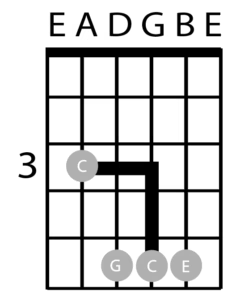 We know that the “two strings up and two frets back” rule can give us the same note but an octave up. We can do that from the 6 string and the 5 string. Let’s concentrate on the 5 string first. So C on the 5 string is at the 3rd fret and consequently, on the 5th fret of the G string. That gives us our one note in two places!
Starting with C on the 3rd fret of the A string, we can see D on the open D string, E on the 2nd fret, F on the 3rd and G on the 5th. The G on the 5th fret is important to us! Now we have 1 and 5, we just need 3!
Starting with C on the 3rd fret of the A string, we can see D on the open D string, E on the 2nd fret, F on the 3rd and G on the 5th. The G on the 5th fret is important to us! Now we have 1 and 5, we just need 3!
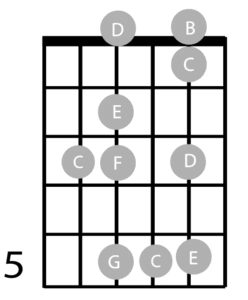
We already had our one note, using the “two string up and two frets back” idea, so that gives us another 1 note at the 5th fret. Excellent! But we still need our 3 note, so if we look at the open B (2) string, we can count up one fret to C then two frets to D and two more frets to E. And that’s all we need to make a C Major chord!
Billy Joel: “I think music in itself is healing. It’s an explosive expression of humanity. It’s something we are all touched by. No matter what culture we’re from, everyone loves music.”
Discover more from Guitar Lessons and Performance - Paul Elwood
Subscribe to get the latest posts sent to your email.